For most homeowners, architectural design is the first major step toward building or renovating yet it’s also the least understood. Whether you’re planning a home addition, remodeling your interior, or designing a custom home, one question comes up immediately:
“How much does an architect cost to draw plans?”
The truth is that pricing varies widely depending on detail, complexity, and the service level you choose. Without understanding how architects structure their fees, it’s easy to misinterpret quotes or compare two firms offering completely different levels of service.
This guide gives you a clear, practical and realistic breakdown of what architects charge per square foot, what affects the rate, and how to estimate your total design budget before your project begins. The explanations below reflect real world architectural practice not generic assumptions.
What Does “Per Square Foot” Pricing Actually Mean?
When architects charge “per square foot,” they are basing the cost on the gross internal area being designed. This includes all conditioned, habitable, structurally significant spaces.
Included in per square foot design fees:
- Living rooms, dining rooms, family rooms
- Bedrooms and bathrooms
- Kitchens and pantries
- Finished basements
- Attics being converted to habitable space
- Home extensions or additions
- Any interior area requiring structural or MEP coordination
Typically NOT included:
- Patios, decks, verandas
- Landscape design
- Driveways or exterior paving
- Detached, unconditioned garages
- Outdoor entertainment structures
This pricing model is popular because it scales logically. A modest 400 sq ft addition requires far less work than a 4,000 sq ft luxury remodel.
Other pricing models architects may use:
- Flat fee for simple, clearly defined scopes
- Hourly for consultations or revisions
- Percentage of construction cost (typically 5%–15%)
Even though architects offer multiple pricing models, per-square-foot pricing remains the easiest for homeowners to understand and compare.
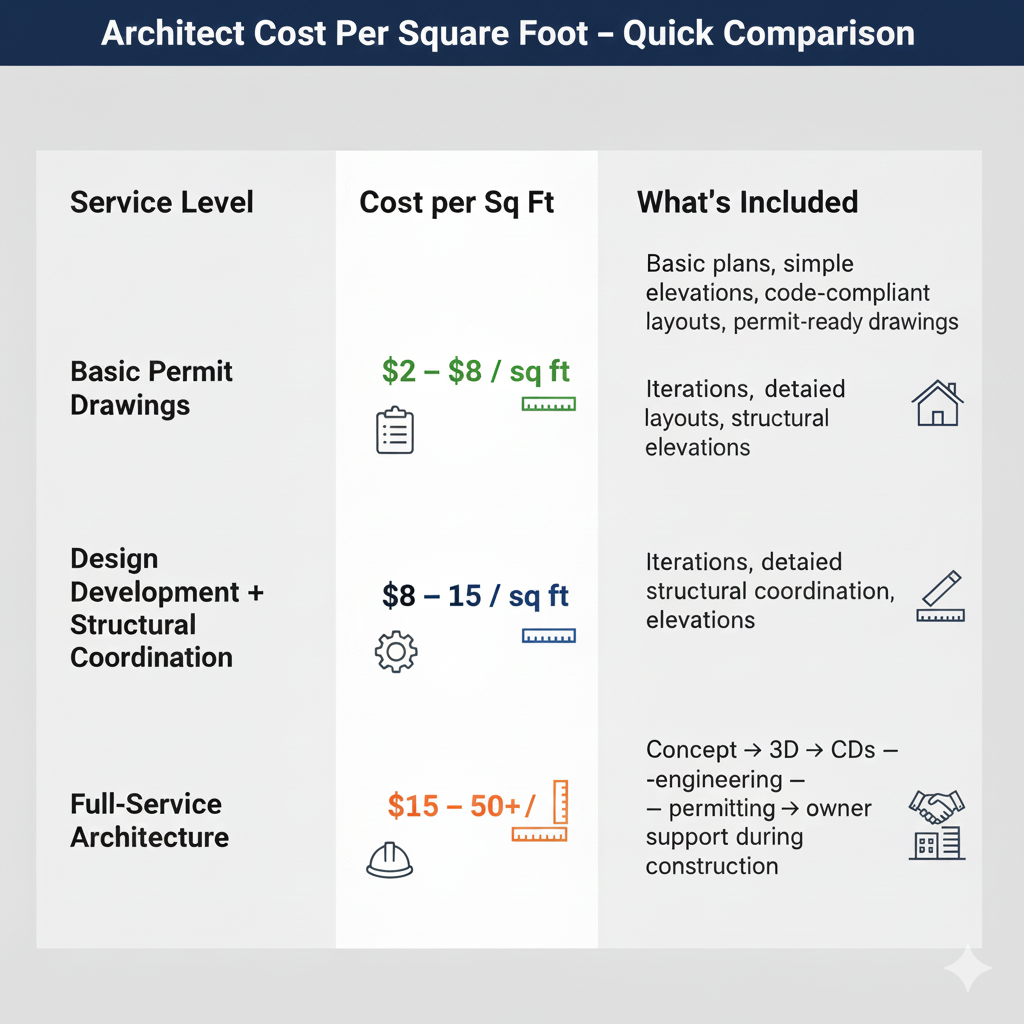
These ranges reflect real residential architectural pricing across North America and are suitable benchmarks for 2025.
1. Basic Floor Plans & Permit Drawings (Entry-Level)
Best for: Simple interior remodels, non-structural changes, straightforward additions.
Basic drawings include:
- 2D floor plans
- Code-approved layouts
- Basic elevations
- Minimal structural review
This level is sufficient only when no major structural changes are involved. It offers affordability but limited customization, and contractors may request clarifications later because technical detail is minimal.
Strengths:
- Lower cost
- Faster turnaround
- Meets minimum permit requirements
Limitations:
- Not suitable for complex builds
- Less detail means higher risk of site changes
- Fewer design options and weak aesthetic development
2. Design Development + Structural Coordination (Mid-Level Architecture)
This is the most commonly selected service tier.
Best for:
- Additions
- Layout reconfigurations
- Structural changes
- Mid-size renovations
- Home expansions
Here, the architect refines:
- circulation and room flow
- window and door placement
- layout efficiency
- natural lighting strategies
- preliminary structural concepts
Coordination with structural engineers is included. The level of detail ensures contractors can price more accurately and you get a design that feels intentional, functional, and tailored.
Strengths:
- Balanced cost vs quality
- Enough detail for accurate bidding
- Higher design control
- Suitable for most homeowner needs
Limitations:
- More time and cost than basic drawings
- May still require interior designer support for high detail finishes
3. Full Architectural Service (Premium Complete Package)
This is the highest level of involvement.
Best for:
- Custom homes
- High-end renovations
- Complex structural builds
- Multi-story additions
- Homes requiring permit strategy and consultant management
- Clients wanting a seamless, fully supported process
Includes:
- Concept design
- 2D + 3D modeling
- Full construction documents (CDs)
- Structural and MEP coordination
- Finishes, materials, millwork details
- Permit management
- Site review and construction assistance
This tier delivers the most value long term. Well-coordinated CDs reduce errors, prevent delays, and save thousands during construction.
What Influences the Architect’s Per-Square-Foot Rate?
Architectural pricing isn’t random. Most architects base their fees on a mix of time, risk, responsibility, and the level of detail required. Key drivers include:
1. Project Complexity
Complexity determines design hours and coordination effort. Examples of high-complexity projects:
- Structural reconfiguration
- Load-bearing wall removals
- Sloped or narrow lots
- Historic buildings
- Multi-level additions
- Custom architectural features
More complexity = higher liability + more drawings = higher fee.
2. Level of Detail in Drawing Package
Higher detail means:
- more sections
- more elevations
- more interior drawings
- clearer specifications
- more contractor questions answered on paper instead of on-site
Higher detail reduces construction problems but increases design hours.
3. Architect Expertise
Experienced architects:
- identify future problems early
- reduce contractor conflicts
- deliver more buildable solutions
- coordinate better with engineers
This efficiency is reflected in their pricing.
4. Turnaround Time
Fast deadlines increase cost because architects must reprioritize workload and accelerate consultant coordination.
5. Geographic Region
Urban centers with strict zoning and complex building codes (NYC, LA, SF, Toronto, Vancouver) have higher architectural fees.
Architect Cost Per Square Foot vs Percentage of Construction Cost
Some architects charge 5%–15% of construction cost instead of per sq ft.
Example:
Estimated construction cost = $300,000
| Service Level | % Fee | Total |
| Basic | 5% | $15,000 |
| Full Service | 10% | $30,000 |
| Complex/Luxury | 15% | $45,000 |
Percentage-based fees are best when homeowners need long-term involvement and intense coordination.
Do You Really Need an Architect?
Yes if you want a safe, buildable, code-compliant project that doesn’t fall apart during construction.
Architects prevent:
- mismatched dimensions
- structural issues
- permit rejections
- expensive change orders
- contractor misinterpretations
Skipping the architect might feel cheaper upfront, but it’s one of the most common causes of project overruns.
Types of Architectural Drawings and What Each Costs Per Square Foot
Understanding the different drawing phases helps you compare quotes more intelligently.
1. Schematic Design (SD)
Cost: $1–$4 per sq ft
Establishes the project’s vision:
- layout options
- massing ideas
- preliminary furniture plans
- early architectural direction
This phase determines 70% of the design outcome.
2. Design Development (DD)
Here the architect:
- refines every room
- optimizes lighting and circulation
- adjusts structural components
- chooses window/door systems
- plans preliminary materials
This phase forms the backbone of construction documents.
3. Construction Documents (CDs)
The most detailed and time-intensive stage.
Includes:
- dimensioned plans
- sections & wall details
- window & door schedules
- electrical and lighting plans
- interior elevations
- structural coordination
Well executed CDs reduce construction errors by 60%+.
How to Estimate Your Total Architectural Cost
Formula:
Total Cost = Total Sq Ft × Rate per Sq Ft
Example 1: Simple Addition
500 sq ft × $8 = $4,000
Example 2: Mid-Level Remodel
1,200 sq ft × $12 = $14,400
Example 3: Full-Service Custom Home
3,000 sq ft × $25 = $75,000
These ranges vary but offer realistic budgeting benchmarks.
What’s NOT Included in Per-Sq-Ft Pricing?
Architectural fees usually exclude:
- Structural engineering
- Mechanical/Electrical/Plumbing engineering
- Site surveys
- Soil/Geotech reports
- Energy compliance calculations
- Interior design & millwork drawings
- Landscaping
- Permit fees
- Construction administration (site visits, RFIs, etc.)
Always request a deliverables list before signing.
How to Choose the Right Architect for Your Budget
Price matters but it’s not the only factor. Here’s what to look at.
1. Portfolio Fit
Choose an architect who has completed similar:
- additions
- remodels
- structural changes
- custom homes
This ensures they already understand your project requirements.
2. Service Level Alignment
Don’t overpay for unnecessary extras.
But don’t underpay for insufficient detail both lead to costly issues.
3. Transparent Pricing Structure
A reliable architect gives:
- clear scope
- defined phases
- fixed inclusions and exclusions
- realistic timelines
Vague proposals lead to misunderstood expectations.
4. Communication Ability
Good architects ask smart questions and translate design concepts clearly.
Poor communication leads to delays and errors.
5. Project Management Skill
Strong architects:
- predict permit issues
- coordinate efficiently
- prevent costly site errors
- protect the homeowner from avoidable expenses
If you want professional, well coordinated designs that minimize construction mistakes and deliver long term value, MK Architectures provides structured, transparent, and detail driven architectural services tailored to both small and large residential projects.
How to Reduce Architectural Costs Without Sacrificing Quality
You can be smart about fees without cutting corners.
1. Be Clear About Your Vision Early
The more decisive you are, the fewer revisions you’ll pay for.
2. Limit Unnecessary Customization
Focus on custom elements that improve functionality not vanity.
3. Retain Structural Integrity Where Possible
Minimizing major structural changes significantly lowers design and engineering fees.
4. Choose Only the Service Level You Need
Not every project requires CD-level detail or 3D modeling.
5. Bundle Project Elements
If renovating multiple areas, having one unified design reduces coordination costs.
Common Mistakes Homeowners Make When Hiring an Architect
Most common issues:
- Choosing based on price alone
- Not comparing deliverables
- Hiring the architect after the contractor
- Underestimating the need for engineering
- Ignoring timelines and revision limits
Avoid these to protect your budget and schedule.
Is Per-Sq-Ft Pricing Better Than Hourly or Flat Fee?
Each pricing model has its place.
Per Sq Ft:
Best for most residential projects. Predictable, scalable.
Hourly:
Best for consultations or small scopes.
Flat Fee:
Good for simple, clearly defined work.
Percentage of Construction Cost:
Best for full-service, large, or complex projects requiring ongoing involvement.
How Long Does it Take to Produce Architectural Drawings?
| Drawing Type | Timeline |
| Basic plans | 2–4 weeks |
| Full CDs | 4–12 weeks |
| Complex custom homes | 3–6 months |
Rushing increases both cost and mistakes.
Conclusion: How Much Should You Budget for Architectural Plans Per Square Foot?
Pricing Summary
- $2–$8 per sq ft: Basic permit drawings
- $8–$15 per sq ft: Mid-level design with coordination
- $15–$50+ per sq ft: Full-service architectural involvement
Where your project lands depends on:
- complexity
- architectural detail
- structural scope
- timeline
- region
- service level
High quality architectural planning is an investment, not an expense. When your drawings are accurate, detailed, and well coordinated, everything downstream cost, schedule, compliance, and build quality improves dramatically.
Also Read: Cad Drafting Services Prices
Also Read: 10 Types of Architectural Drawings
FAQs
1. Is the cost per square foot negotiable?
Only when scope is simplified. Complex projects rarely discount.
2. Why do architects have a minimum fee?
Even small projects require meetings, code research, drafting, and coordination.
3. Do remodels cost more than new builds?
Yes existing structures add complexity.
4. Can I hire an architect just to review plans?
Yes. Many offer plan reviews or partial services at reduced scope
